Sponsored by


Today in 30 seconds
Alphabet’s AI edge: $GOOGL ( ▲ 3.22% ) doesn’t need Gemini to be the #1 chatbot—Search, YouTube, Cloud, Waymo, and its massive distribution already give AI multiple ways to drive growth.
The bigger AI play: Nvidia sells the chips, Nebius and CoreWeave build infrastructure, Palantir deploys enterprise AI—but Alphabet already has the customers and ecosystem.
Honest catch: Competition, huge AI infrastructure costs, and regulation could pressure the business.
Action: Don’t chase the next chatbot winner. Look for companies turning AI into higher productivity, stronger earnings, and new revenue over five years.

What if the best AI opportunity isn't the company with the smartest chatbot—but the one that already controls the platforms, customers, data, and infrastructure needed to make AI enormously profitable? 👀
Discover why Alphabet could be one of the most overlooked ways to play the AI boom—and what could ultimately prove the market right or wrong.
Read through to the end — the framework at the close is the part most busy investors can reuse every week.
5-Year Horizon · $SNX: Flat for years, then the gain showed up late
"The stock market is a device for transferring money from the impatient to the patient."
— Warren Buffett
A fixed $500 a month is a patient habit: you keep buying through the dull stretch, not only after the line turns up.
TD Synnex Corp. $SNX ( ▼ 3.01% ) closed at $269.21. Five years earlier it was about $115.29. That is a +$153.92 move, or +133.51% in total — roughly 18.5%/yr on average if you held the whole stretch. That pace is stronger than most long-run market averages. It is unusual, and it is not a number to project forward blindly.
Story: A long, choppy base near $100–$150, then a late climb and a small fade from the peak.
Math: $115.29 → $269.21 · +133.51% (~18.5%/yr avg)
If $500/mo: $30k in → roughly $68,000–$72,000 if that average multiple somehow repeated (it usually does not).
Look for on the chart: the quiet 2022–2025 range, the 2026 lift toward the $296.47 52-week high, and the pullback to $269.21 — DCA would have bought more shares in the flat years and fewer into the late strength.

Lesson: Late compounding. A large share of the five-year gain arrived near the end of the window, after years that looked ordinary. Past results never guarantee the future — the next five years do not have to rhyme with this path.
Next Horizon: another verified 5-year chart, same $500/month frame, same honest catch.
Want a cleaner look at this name? Open SNX on Snowball Analytics — price, fundamentals, and history in one place. Context for the chart above, not a buy signal.
Sponsored resource
Are you ready for what's coming next?

UBS, one of the world's largest banks warns there's a 93% chance of recession in 2026.
Claim your free Wealth Protection Kit and learn how Americans are protecting their savings with gold.
AI agents built to get work done

Skydive agents take on work for you, using the same tools your team already uses.
Talk to your agent on the web, Slack, email, iMessage, or right from your terminal. Wherever you pick up the conversation, your agent keeps the context.
Put agents to work across customer support, sales, marketing, engineering, ops, and more.
Give your agent a job. They’ll take it from there.
Everyone Is Chasing AI. The Real Bargain Might Be Hiding in Plain Sight
The AI boom has created an obvious group of winners. Nvidia (NVDA) supplies the chips, Microsoft (MSFT) and Amazon (AMZN) are building massive cloud businesses, Meta (META) and Alphabet (GOOGL/GOOG) are putting AI in front of billions of users, while companies such as Nebius (NBIS), CoreWeave (CRWV), and IREN (IREN) are building the infrastructure needed to keep the entire system running.
But when almost everyone is looking at the same AI winners, a different opportunity can emerge.
Sometimes the more interesting investment is not the company with the newest AI product. It is the company that already has an enormous business, massive distribution, valuable data, and the infrastructure to turn AI into another source of growth.
That is what makes Alphabet worth a closer look.
Google May Be More Than an AI Bet
The easy way to look at Google is to ask whether Gemini can compete with ChatGPT, Claude, or other AI assistants.
That is an important question, but it is not the entire investment thesis.
Alphabet owns one of the world's most valuable digital ecosystems. Search remains its core business, but it also owns YouTube, Google Cloud, Waymo, AI research, custom chips, advertising technology, and subscription businesses.
That gives Alphabet several ways to benefit as AI adoption increases.
Google can use AI to make Search more useful. YouTube can use AI to improve recommendations, creation tools, and monetization. Google Cloud can sell the computing power and software businesses need to build their own AI systems. Waymo gives Alphabet exposure to autonomous driving without requiring the company to create an entirely new business from scratch.
The most important part is that Alphabet already has the customers.
An AI startup may have an excellent model but still need to spend enormous amounts of money acquiring users. Google can introduce AI into products that people already use every day.
That distribution is difficult to replicate.
The Real AI Battle Is Happening Underneath the Apps
The AI conversation often focuses on which model is smartest.
ChatGPT, Anthropic's models, Google's Gemini, Meta's AI products, and Grokbot are all competing for attention. Meta is also pushing further with Muse, its next generation of AI experiences and agents.
But behind every one of these systems sits an enormous requirement for computing power.
That is why companies such as Nvidia, Nebius, IREN, and CoreWeave have become important parts of the AI story.
Nvidia provides the specialized chips that power many of today's AI workloads. The neocloud companies are taking a more focused approach by building data-center capacity specifically for AI computing.
This creates an interesting second layer to the AI opportunity.
You do not necessarily have to know which chatbot becomes the ultimate winner. If AI adoption continues, the companies providing the computing infrastructure can still benefit from the growth of the entire industry.
Nebius and Palantir Show Where AI Is Going Next
The partnership between Nebius $NBIS ( ▼ 5.5% ) and Palantir $PLTR ( ▲ 3.64% ) is particularly interesting because it points toward a more specialized AI market.
The two companies are working toward a sovereign AI infrastructure offering, with Nebius serving as Palantir's preferred sovereign AI infrastructure partner.
The basic idea is important: organizations increasingly want to use advanced AI without giving up control over sensitive data, models, or computing environments.
For Palantir, this strengthens the infrastructure supporting its enterprise AI platform.
For Nebius, it creates another path into organizations that require dedicated AI computing.
This is a reminder that the next stage of AI may not simply be about better chatbots. It may be about who controls the infrastructure, data, security, and deployment environment behind those systems.
Meta Has Something AI Startups Cannot Easily Buy
Meta $META ( ▲ 2.71% ) has another advantage that deserves attention: distribution.
Facebook, Instagram, WhatsApp, and Messenger already connect Meta with billions of people. That gives its AI products an enormous built-in audience.
Muse could eventually become more than an AI assistant. The potential extends into commerce, social media, content creation, advertising, subscriptions, and business management.
Imagine an AI system that does not simply answer a question but helps someone discover a product, complete a purchase, create content, manage a business task, or interact with other people.
Meta already owns many of the platforms where those activities happen.
That creates multiple possible ways to monetize AI without relying entirely on a standalone subscription.
And that is where Meta's AI strategy becomes particularly interesting: the value may come less from charging people to use AI and more from putting AI into the middle of activities that already generate revenue.
Exploring AI Voice With SuperBloom

For Deel's "Feeling of Deeling" campaign, agency SuperBloom needed one consistent brand voice across markets—deployed fast, without sacrificing quality or consent. In this on-demand video session, SuperBloom and Voices break down the casting, production, and governance, plus what they'd do differently and where AI voice is headed next.
AI Is Also Changing the Economics of Companies
There is another part of the AI story that can easily get overlooked: productivity.
One useful way to measure that is revenue per employee.
Nvidia's revenue per employee changed dramatically as demand for AI computing exploded. Meta experienced a difficult period after years of aggressive expansion but has since improved efficiency. Microsoft has benefited from the combination of cloud computing and enterprise software, while Amazon has been working to improve productivity after years of rapid expansion.
Uber $UBER ( ▲ 1.34% ) has also increased revenue per employee as its platform scales, while Netflix $NFLX ( ▲ 3.77% ) has steadily improved the amount of revenue generated by its workforce.
Other companies tell a different story.
Apple $AAPL ( ▲ 0.24% ) has seen relatively limited movement in revenue per employee over the past several years, while Tesla $TSLA ( ▼ 1.77% ) has also remained comparatively flat since 2022.
That does not mean Apple or Tesla are poor businesses.
The more useful takeaway is that AI could create a meaningful difference between companies that merely adopt AI and companies that use it to produce substantially more output without increasing costs at the same rate.
For a five-year investment, that difference can matter enormously.
Look Beyond the Obvious AI Stocks
The AI opportunity also reaches companies that are not usually described as pure AI plays.
PayPal $PYPL ( ▲ 0.58% ) could benefit as AI changes digital commerce and the way consumers interact with payments.
Oracle $ORCL ( ▼ 3.65% ) is benefiting from growing demand for cloud infrastructure and enterprise computing.
Adobe $ADBE ( ▲ 5.3% ) is integrating AI into creative and productivity software, giving customers more powerful tools while creating opportunities for new products and monetization.
Micron $MU ( ▼ 5.25% ) benefits from the enormous memory requirements associated with modern AI systems.
Then there are the companies sitting at different points across the AI stack.
Nvidia supplies the computing power. Microsoft and Amazon provide cloud infrastructure. Palantir focuses on enterprise AI applications. Nebius, CoreWeave, and IREN are expanding specialized infrastructure. Alphabet and Meta have massive consumer distribution.
Each is making a different bet on the same technological shift.
Why Alphabet Stands Out?
Alphabet's appeal is that it does not need every part of its AI strategy to succeed.
Search already generates substantial cash flow.
YouTube provides another enormous advertising and subscription platform.
Google Cloud gives Alphabet exposure to enterprise AI spending.
Waymo offers exposure to autonomous transportation.
Its custom chips can help support its own infrastructure.
And Gemini gives Alphabet a way to compete directly in generative AI.
That creates a collection of potential growth engines inside one company.
The risk is that Google's existing businesses could be disrupted faster than its new AI products can replace the economics. Competition from Microsoft, OpenAI, Meta, Amazon, Nvidia, and other AI companies remains intense. Alphabet also faces the possibility of higher infrastructure costs and continued regulatory scrutiny.
So the argument is not that Google is risk-free.
It is that the market may be underestimating what Alphabet looks like if its existing businesses remain strong while AI creates additional growth opportunities.
The Five-Year Question Is More Important Than the Next AI Winner
For someone with limited time to follow markets every day, trying to determine which AI model is slightly better this month can become a never-ending exercise.
There is a more useful question:
Which companies could be meaningfully more profitable five years from now because AI changes the economics of their businesses?
That question points toward a much broader group.
Alphabet could combine Search, YouTube, Cloud, Waymo, AI, and custom chips.
Meta could turn its enormous social platforms into a distribution network for AI-powered commerce and services.
Nvidia could remain a critical supplier of the computing infrastructure required by the industry.
Microsoft and Amazon can monetize AI through their massive enterprise and cloud ecosystems.
Palantir and Nebius can benefit as businesses and governments demand more controlled AI environments.
IREN and CoreWeave can benefit from continued demand for specialized computing capacity.
And companies such as Apple, Tesla, Uber, Netflix, PayPal, Oracle, Adobe, and Micron have their own opportunities to use AI to improve existing businesses.
The biggest opportunity may therefore not be finding the next company everyone is talking about.
It may be finding the companies where AI is quietly improving productivity, expanding distribution, strengthening margins, and creating new revenue streams before those improvements are fully reflected in the valuation.
For Alphabet, that possibility is particularly compelling because the company already has the infrastructure, customers, cash-generating businesses, and global reach needed to make AI work at enormous scale.
The AI race is still young.
The more interesting question is not who wins the next chatbot battle.
It is who turns AI into an enduring business advantage.
Tip: When evaluating AI stocks for a five-year horizon, look beyond the latest model or headline and focus on the companies that can convert AI spending into higher productivity, stronger earnings, and lasting competitive advantages.
Sponsored resource
Demystify AI for Your Business in Just 4 Steps
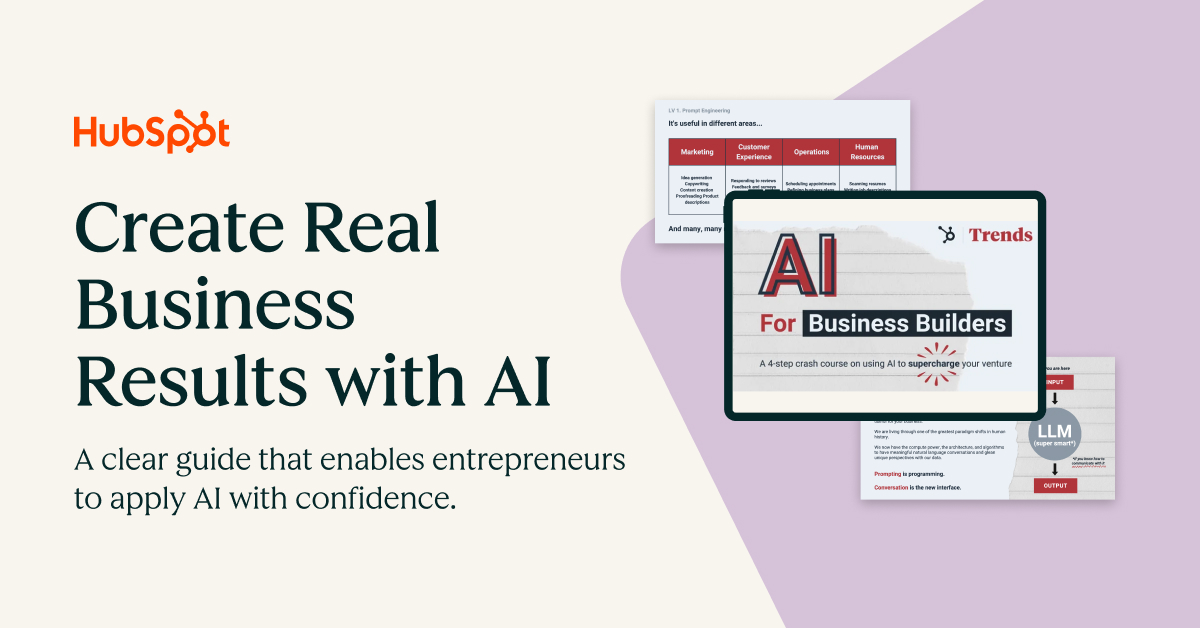
Overwhelmed by AI? HubSpot's free guide cuts through the noise. Get the ultimate crash course for non-technical entrepreneurs who want to harness AI's power—without getting lost in the jargon.
"AI for Business Builders" delivers:
• A 4-part roadmap to AI mastery
• Jargon-free explanations of large language models
• Practical prompt engineering tips you can use today
• Real-world examples of AI boosting businesses like yours
Arm yourself with the knowledge to make informed AI investments and skyrocket your startup's growth.
Download Your Free Guide Now
Want a simple next step for the $500 habit?
Our Fast Track Blueprint walks through a trusted online broker setup and a clear portfolio starting path.

That’s it for this episode
Thanks for reading. This format is built to be fast to open, clear to understand, and useful enough to act on — without pretending past returns continue forever.
Disclaimer: This newsletter is for informational purposes only and is not financial advice. Consult a qualified advisor before investing.