Sponsored by


Robinhood Markets is no longer evolving as just a trading app—it is gradually repositioning itself as a full-scale financial platform where users can manage investing, banking, credit, and long-term capital allocation in one ecosystem. While the company was once judged primarily on trading activity and market volatility, the real signal of its transformation now lies elsewhere. Net deposits—the flow of new capital into the platform—have become the clearest indicator of user trust and financial consolidation. As Robinhood expands its product suite and deepens wallet share, the business is increasingly shifting toward a structure where growth is driven less by market cycles and more by how much of a user’s financial life remains inside the platform.
His Father Got Parkinson's. He Built Robots Instead.

Clint Brauer grew up on his family's Kansas farm. His dad sprayed the same chemicals every American farmer sprays. Years later: Parkinson's. Clint walked away from a tech career to build a different way. Today his company, Greenfield Robotics, runs a patented fleet of autonomous bots that slice weeds with centimeter precision, day or night, herbicide-free.
Greenfield is now opening shares to everyday investors under Reg A+. Reserve during Test the Waters and you lock in a 5% bonus that can grow to 20% the week the round goes live. The US has 250 million acres at stake.
Greenfield Robotics is Testing The Waters under tier 2 of Regulation A. No money or other consideration is being solicited, and if sent in response will not be accepted. No offer to buy the securities can be accepted and no part of the purchase price can be received until the offering statement filed by the company with the SEC has been qualified by the SEC. Any such offer may be withdrawn or revoked, without obligation or commitment of any kind, at any time before notice of acceptance given after the date of qualification. An indication of interest involves no obligation or commitment of any kind. “Reserving” shares is simply an indication of interest. There is no binding commitment for investors that reserve shares in this manner to ultimately invest and purchase the shares reserved of the company, or to purchase any shares of the company whatsoever.

In this breakdown, we explore how Robinhood $HOOD ( ▲ 2.9% ) Markets is quietly transitioning from a brokerage into a financial operating system. The key driver is net deposits, which reveal whether users are consolidating assets or spreading them across multiple institutions. As banking, credit, advisory, and investing features expand globally, Robinhood is beginning to compete not just with trading platforms, but with banks, wealth managers, and credit providers. The central question is no longer about trading volume—it is about how deeply the platform can embed itself into everyday financial behavior.
Let’s embark on this transformative journey together and position your portfolio for success in this evolving market landscape!
Be sure to read through to the end to catch all the valuable insights this newsletter delivers to your inbox today.
Three months running. No losses on the open book in 2026 so far.
Adam Mesh has six open options trades on the book right now.
Every one of them is in the green.
Here's his 2026 record as of today:
• SNDA — opened Feb 26. +203. Still open.
• OWL — opened March 5. +735. Still open.
• BB — opened April 21. +474. Still open.
• ASPI — opened April 23. +800. Still open.
• NOK — opened April 30. +480. Still open.
• BULL — opened May 14. +156. Still open.
Total unrealized profit across the book: $2,848 and counting.
That's not a back-tested track record. Those are live open positions, dated and verifiable.
He'll be the first to tell you not every trade wins. He's been doing this for 30 years. He's had plenty of losers. Every trader has.
But the math behind his core strategy is built so the odds lean in his favor before he ever clicks submit.
He just put together a free video that walks through the four strategies behind every name on that list.
You'll see the trade structure. The setups. The exit rules. The reasons most options traders blow up their accounts and how to not be one of them.
Watch the free options video breakdown - drop your email to start →
MPC's Strong Refining Run: Energy Profits and Your $500 Monthly Plan
Picture this: Five years ago, Marathon Petroleum $MPC ( ▼ 5.3% ) stock traded around $62 per share. Today in June 2026, it closes at $242.91 — a solid +288% gain. The chart shows a steady upward trend with good acceleration in recent years, supported by strong refining margins and energy market conditions.
The 52-week high reached $272.46, showing the stock has already climbed higher during strong periods.Keeping it simple: The compound annual growth rate (CAGR) over these five years is about 31%. If this pace continues, it means reliable yearly gains that compound steadily over time.
Now imagine using dollar-cost averaging (DCA): adding $500 every month for the next five years. This totals $30,000 invested from your pocket over 60 months. You buy more shares on dips and fewer on rises, which helps keep your average cost balanced.

If MPC follows a similar historical pace around 31% annual growth, your monthly $500 contributions could grow your investment to approximately $62,000 by the end of five years. That means a gain of roughly $32,000 beyond what you put in — a solid 107% overall return from consistent investing.
Past performance doesn't guarantee the future — oil prices, refining margins, or market conditions can shift the path. But MPC is a major player in refining and midstream with strong operations. Your $500 monthly plan stays simple and easy to maintain, letting compounding build real value.
The ongoing need for fuel and energy products keeps supporting this sector. Staying disciplined through any temporary pullbacks is what usually leads to good long-term results.
Ready to build with this kind of energy strength?
🏦📊 Robinhood and the New Financial Operating System: How Net Deposits Became the Real Story
For years, Robinhood Markets has been viewed through a narrow lens: a trading app that lowered the barrier to stocks and options for retail investors. That framing is increasingly outdated.
The company’s leadership now describes its direction as a “financial super app,” a structure that goes far beyond order execution or commission-free trading. The ambition is not simply to facilitate investing, but to become the central platform where an individual manages nearly every financial activity.
That evolution is being built across three operational pillars:
Becoming the default platform for active traders, where execution quality, speed, and tools make switching away inefficient
Expanding wallet share, where users consolidate banking, credit, advisory, and investment activity in one ecosystem
Scaling into a global financial network that serves retail users, institutions, and eventually cross-border financial flows
The strategic implication is straightforward but significant: Robinhood Markets is positioning itself less like a brokerage and more like financial infrastructure.
This is where the competitive dynamic shifts. Traditional brokerage firms such as Charles Schwab and Fidelity built their scale during a pre-mobile financial era. Modern platforms now compete not just on fees, but on product integration, user experience, and asset consolidation.
The most important metric in that transformation is no longer trading volume.
It is net deposits.
Why net deposits matter more than market direction
Net deposits have become the clearest measure of trust in Robinhood Markets.
Unlike revenue or trading activity, net deposits reflect whether users are actively moving more capital into the platform over time. This metric is less sensitive to short-term market cycles and more tied to behavioral consolidation.
The company tracks this as a core performance indicator because it directly correlates with long-term revenue expansion. More assets on the platform typically translate into higher engagement across products such as options trading, margin, cash management, and advisory services.
Recent data reinforces this pattern:
Even during mixed macro environments — including interest rate uncertainty, technology sector volatility tied to companies like NVIDIA and Broadcom, and broader geopolitical instability — net deposits have continued to grow at a strong pace.
This consistency suggests something more structural than cyclical behavior.
It points to customer consolidation.
As users adopt additional features such as banking, credit offerings, and advisory tools, more of their financial lives remain inside Robinhood Markets rather than being spread across multiple institutions.
One of the most notable examples is the banking product, which has already accumulated billions in deposits and hundreds of thousands of users shortly after rollout. Importantly, this growth is not dependent on market performance. It is tied to usage behavior.
That distinction matters.
In traditional brokerage models, revenue fluctuates heavily with market volatility. In a more integrated financial platform model, revenue becomes partially insulated as users engage with multiple non-market-dependent services.
This is where Robinhood Markets begins to resemble a financial operating system rather than a single-purpose app.
The size of the opportunity is no longer theoretical
The long-term investment case is increasingly anchored in total addressable market expansion rather than incremental product improvements.
The combined opportunity across U.S. financial services is substantial:
Retail brokerage assets alone are estimated at roughly $20 trillion
Retirement assets add another approximately $20 trillion
Advisory and managed assets contribute an additional $7–10 trillion
These figures exclude emerging categories such as integrated banking, credit products, and crypto-related financial services.
Against this backdrop, Robinhood Markets currently manages a fraction of total potential assets relative to incumbents that operate at multi-trillion-dollar scale.
That gap is central to the company’s strategy.
Growth is no longer primarily about acquiring first-time investors. It is increasingly about capturing a larger share of existing investors’ total financial footprint.
This is where the “wallet share” model becomes critical.
Instead of competing solely with trading platforms, Robinhood Markets is now indirectly competing with:
Traditional banks for deposits
Credit card issuers for spending behavior
Wealth management firms for long-term capital allocation
Crypto platforms for alternative asset exposure
Each new product expansion increases switching costs for users. Once banking, trading, credit, and investing exist in a single interface, fragmentation becomes less convenient.
That friction shift is one of the most powerful retention mechanisms in modern financial services.
It also explains why net deposits remain the central focus: they reflect whether users are centralizing or dispersing their financial activity.
The misunderstanding around Robinhood’s business model
A persistent misconception about Robinhood Markets is that it remains primarily dependent on trading activity and market volatility.
While trading remains a meaningful component of revenue, the internal structure of the business has expanded significantly.
Three structural changes are reshaping its economics:
1. Product diversification beyond trading
The platform now includes banking, credit, retirement accounts, advisory tools, and international offerings across regions such as the UK, EU, Canada, and emerging Asian markets including Singapore.
This diversification reduces reliance on any single revenue stream.
2. Shift toward asset consolidation
Rather than competing for isolated trades, Robinhood Markets benefits when users move entire portfolios onto the platform. This includes cash holdings, retirement assets, and recurring deposits.
This is why net deposits matter more than trading volume. Deposits indicate long-term platform commitment.
3. Institutional convergence
Historically, retail and institutional finance operated in separate ecosystems. That separation is narrowing.
Retail users increasingly expect institutional-grade tools such as advanced execution, analytics, and low-cost structures. Meanwhile, institutional participants increasingly value the design simplicity and cost efficiency that originally defined retail platforms.
Robinhood Markets is positioning itself at the intersection of both expectations.
The result is a platform that does not fit neatly into legacy categories. It is neither purely retail brokerage nor traditional institutional infrastructure. It is moving toward a hybrid model where both segments interact within a unified system.
What matters next for Robinhood Markets
The long-term trajectory of Robinhood Markets depends on execution across three interconnected variables:
Sustaining net deposit growth
Historical data shows that even during volatile macro periods — including rate shifts and equity sell-offs affecting companies like NVIDIA, AMD, and Broadcom — net deposits have continued to rise. Maintaining this trend is essential for validating the platform consolidation thesis.
Scaling non-trading revenue streams
Banking, credit products, and advisory services represent stabilizing forces within the revenue mix. As adoption expands, reliance on trading-driven revenue fluctuations should gradually decrease.
Expanding geographic and institutional reach
International expansion and institutional product development introduce new customer segments that operate under different financial cycles and behaviors compared to U.S. retail investors.
The risk profile remains tied to execution. Expanding into multiple financial categories introduces complexity, regulatory considerations, and integration challenges.
However, the upside case is equally structural.
If Robinhood Markets continues increasing wallet share across banking, investing, and credit while sustaining net deposit growth, the business evolves into something closer to a full-stack financial ecosystem rather than a single-product platform.
That shift is what markets are gradually reassessing.
Not as a trading app. But as an infrastructure layer for personal finance. And in that framing, the most important number is not how often users trade.
It is how much of their financial lives they choose to keep inside Robinhood Markets.Ready to Revolutionize Your Wealth?
Here's what's waiting for you:
📈 Step-by-Step Guide: Start Investing in Minutes with Our Chosen Online Broker
🔍 Expert Insights: Uncover the Strategies Behind Our Recommended Smart Portfolios
💼 Easy Diversification: Gain Exposure to a Wide Range of Assets with Just a Few Clicks
💰 Long-Term Growth Potential: Build a Portfolio for Consistent Returns Over Time.

💸 Paying the bills
What if your money could drive itself to your goals?
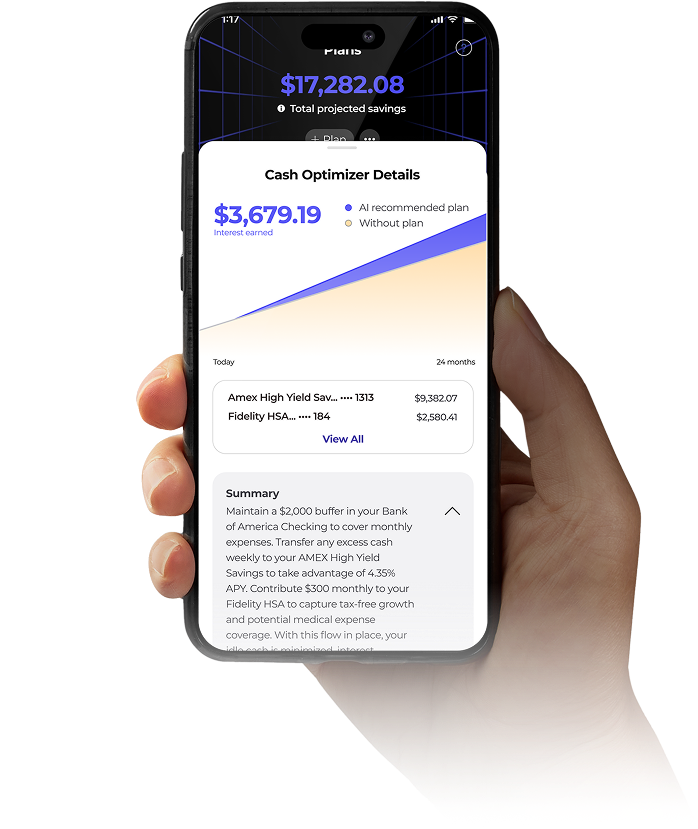
Any bank, any account, Piere makes it possible. In seconds, Piere analyzes your spending, income, wants, and goals, then creates fully automated plans for your money to follow.
- Save money automatically when you get paid — your money moves itself to the right account at the right interest rate
- Repay debt and stay debt free - Piere smartly determines which accounts to pay and when for the biggest impact
- Spend smarter — Piere keeps only the money you need for monthly expenses in your checking, moving the rest to high-yield accounts for safekeeping (and less temptation)
Get started in just seconds, and if you don't grow by at least $120 in your first year, we’ll give you back the difference.
Learn More
efind - Brain food is delivered daily. Every day, we analyze thousands of articles and send you only the best, tailored to your interests. Loved by 510,562 curious minds. Subscribe.

TOP MARKET NEWS
Top Market News - June 23, 2026
Saudi Stocks Slip as Tadawul Index Closes Lower
Saudi equities weakened at the close of trading, with the :contentReference[oaicite:0]{index=0} reflecting broader regional risk sentiment shifts.
Source: :contentReference[oaicite:1]{index=1} :contentReference[oaicite:2]{index=2}
International Stocks Outlook Highlights Global Diversification Trends
Global investors are reassessing international equities as :contentReference[oaicite:3]{index=3} outlines shifting opportunities across developed and emerging markets.
:contentReference[oaicite:4]{index=4}
Energy Stocks Highlighted as Long-Term Investment Opportunities
Energy sector equities gain attention as analysts at :contentReference[oaicite:5]{index=5} identify potential undervalued opportunities in global energy markets.
:contentReference[oaicite:6]{index=6}
Services Stocks Seen as Long-Term Compounders
Long-term investors are increasingly focused on service-based companies as durable compounding opportunities highlighted by :contentReference[oaicite:7]{index=7} market coverage.
:contentReference[oaicite:8]{index=8}
Advertise with Investing Wise Academy
Elevate your financial brand with targeted exposure to savvy investors and market enthusiasts.
Partner with Us
PROMO CONTENT
Can email newsletters make money?
As the world becomes increasingly digital, this question will be on the minds of millions seeking new income streams in 2026.
The answer is—Absolutely!

That’s it for this episode!
Thank you for taking the time to read today’s email! Your support is what allows me to send out this newsletter for free every day.
What do you think of the new format? Please provide your feedback in the poll below, and if you find the newsletter valuable, feel free to share it with other investors!
How would you rate today's newsletter?
Disclaimer: This newsletter is for informational purposes only and should not be considered financial advice. Please consult with a financial advisor before making any investment decisions.